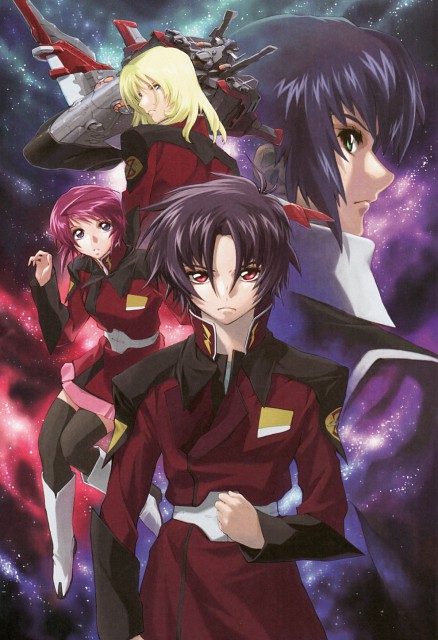
The year is CE 73. Two years after the battle of Jachin Due, tensions still run high between naturals and coordinators. ZAFT has developed several new mobile suits, including several new gundams, and is preparing to unveil them to the world.
However, three of the gundams are hijacked by three of the EAF's Extendeds: Sting Oakley, Auel Neider, and Stellar Loussier. To recover the stolen mobile suits, the new ZAFT battleship Minerva heads out, with Shinn Asuka piloting the new Impulse Gundam. Once again, the world is plunged into a state of war between ZAFT and the EAF. Where will this new war lead? And how will the heroes of the previous war, Athrun Zala and Kira Yamato, react?
Credits: destati
Story & Characters
While I have watched all of the Gundam series and still hold the original Universal Century storyline to be
the best Gundam incarnation up to the present, I will judge Destiny's merits and its shortcomings, not on how much
it has taken from the other installments, but sufficiently through its attributes alone. So I won't go into detail
about how it "ripped off" Gundam designs or plot points from Zeta or Gundam 0083, as some assert, because
esentially the Gundam Series is a tradition, so it is inevitable that different series will have common qualities,
character types or plot twists. The only comparison that should be made with Destiny's story is with its prequel,
Gundam Seed. In this aspect, I have mixed reactions. They tried to aim for a parallel plot in the beginning of the
series in which top secret mobile suits are hijacked( although by the Earth Allince this time around...^^), and
Zaft's Minerva, akin to the Archangel from the previous series, is forced to play a pivotal role despite the
inexperience of its crew and pilots. To be fair to the writers, they actually did a good and concise job in the initial
episodes, especially the Junius 7 drop and the subsequent events. The idea of presenting the story in the eyes of an
entirely different character, although not original, is a good formula when it comes to preserving the
"interest" factor in a sequel, and to keep it from becoming too derivative. Although he is mainly marked as an
infamous figure by certain groups of fans, I think that Shinn Asuka is not a bad choice for a character lead, despite
some of his apparent negative attributes. At first, obviously they were pushing for a character that would act as an
opposite to Kira, to prevent the "carbon-copy problem" that would most likely plague consecutive series with
main characters that are almost the same. So, whilst Kira in Gundam Seed was alternating from reluctance and protective
decisiveness, Shinn was portrayed as dark, vengeful and sometimes unreasonable. ( These "negative traits" do
not paint him as a villain, just as a Byronic hero, at least for me...^^) There are some characteristics that made him
retain my interest, and had he been given the sufficient development, would have made him a truly memorable
character.
Why is that, you ask. It all comes down to character preferences. While the majority of viewers usually go for
the "saviour" character type, or the "pure-hearted underdog", some, myself included, actually enjoy
seeing characters evolve from being "unpalatable" at first. This archtype categorizes violent, self-centered
and sometimes morally impeded individuals, especially their reaction to tragedy, personal or otherwise. Barring some
obvious inherent traits( being impatient and argumentative), Shinn's reaction to his personal loss strikes me as
natural. It is surprising how some expect personal tragedy as being a way to instant enlightenment.^^
It can also be noted that he witnessed his loss in a particularly graphic and gruesome manner, which in a way makes it
more intimately infuriating( in Shinn's view). I mean, I wouldn't be too reasonable after seeing my own family
mangled and torn like that. Having said that, I don't see him as excessively celf-centered or
"unredeemable"(as detractors would say), just driven, confused and arrogant, which strikes me as interesting
for a main character.^^
Now, let us move on to the other "new" characters. Aside from Shinn, the one that left quite an
impression on me was the Chairman himself, Gilbert Durandal( don't sue me, that was the correct spelling, according
to the majority of sources...^^). Some have labeled him as just another manipulative anti-hero, but for me , he was much
more than that. Although little exposition has been made about his background, much of his motivations were actually
shaped by Talia's departure, his friendship with Rau, and his expertise in genetics and eugenic philosophy. As a
"villain", surprisingly, I don't find him as an "epitome of evil or destructiveness" as opposed
to Rau ( their poignant chess dialogues are one of my favourite scenes ), when at last I understood his intentions, they
were very sincere, after all. The fact that people don't aways adhere to the same ideals are the only reason why
his plan wasn't realized. At the same time, some didn't agree to his proposed methods, although I find their
lack of a better option disturbing.^^ As for the others, the ones that stood out include Meer Campbell, who portrayed
the perfect dilemma between subjective truth and reality, Talia Gladys, and Stellar Loissier, although I would have
preferred if she was less mentally impaired, and had more character exposition. I appreciate that the EA's Extended
pilots have been characterized to some degree, a fact that the prequel neglected. Thus stating this, it is clear why I
enjoyed the initial run of Destiny more than the later episodes.
Normally, the new characters should have more time to develop, and if for some reason, the original cast
have to return, the former should take precedence to the latter. Unfortunately, what happened to GS: Destiny was the
opposite, with the returning chracters inexplicably replacing the established "new" ones. The result was that
the series somehow became schizophrenic, trying to be two things at the same time, and consequently, became
fragmented(but not in a good way) and without direction. Instead of focusing in letting the new protagonists mature, the
writers apparently took the easy route and brought back the old ones due to their huge following. Ironically, some
characteristics of the returning cast were somehow out of place, and some completely changed to total opposites of their
previous behaviour, with the following being cases in point:
Kira Yamato- aside from the obvious " invincibility " factor that was added to him in Destiny^^,
his questioning personality( an integral part of his profile in Gundam Seed ) has been thrown out of the window. Thus,
at times he seems high-handed and self-righteous, especially during his confrontations with Athrun and Shinn, and his
opinion of ZAFT.
Lacus Clyne- she went from being a simple peace-loving soul into a sort of authoritarian in Destiny. I also
think she obsesses over Kira a little too much in this series.^^
Cagalli Yula-Atha- one of my greatest disappointments. Her character became totally the opposite of the one
in Gundam Seed. Must be the politics..^_^
Murrue Ramius and Mwu La Fllaga- well, technically Mwu shouldn't be alive if we are going to stick to
realistic laws of physics. Murrue became just a token captain. Sad.
Orb Union- while obviously the symbol for Japan in the Cosmic Era, some of its motives( and Cagalli's)
were muddled and unfortunately, hypocritical. We want peace but we will go to war with ZAFT and ally with the Earth
Alliance? Sink the ship that prevented a full-blown colony drop on Earth? One wonders wether the Orb government is in
over its head.
Athrun Zala- I saw a return of his old form during his days of piloting the Saviour. The old indecision
that plagues him caught up immediately though, and so he went back to the Archangel( again ). I hope the mentor
relationship with Shinn had expanded though, despite the latter being a stubborn student.^^
Another reason why the latter half was a letdown was the unclear stand of some characters on their true
beliefs. An example of this was Kira's assertion that wars need to be stopped( wether the combatants resolve their
differences or not, which is somewhat strange...), and that everyone shouldn't wallow in conflict, but to my
surprise, towards the series' end, he and Lacus actually advocated fighting, citing peoples dreams and ambitions as
reasons behind this. Now that was a little weird if you ask me. I wonder if Shinn isn't the only one confused.^^
Among the episodes, most of the events up until " Nightmare" were good, although the story
really took a downward spiral after that. To be direct, I enjoyed 34 episodes out of 50. In comparison to Gundam Seed,
the sequel had a weaker storyline, ironically for me, due to the rerurn of the old cast rather than faults in the new
protagonists.
Rating: 5
Art
Now, the art has been one of the strong points of the Seed series. The animations are fluid, the colors are crisp and
the backgrounds are sufficient in establishing the mood of each episode, although some 3D elements don't quite mesh
well with the hand-drawn components. The mobile suit designs were deliberately( I think ), inspired from existing ones(
tradition...remember ), so technically, there's nothing really new to see. However, it doesn't mean that they
look bad, in fact, some are awesome, especially the Destiny and the Saviour. The only factors that detract from the
visual experience are repetitive flashback sequences and the tendency of character designs to be similar to one another.
Since both are just carry-over flaws from the previous series, it is unfair to blame it all on the sequel. The sequences
depicting large sections of armed engagements at any given location, especially the usage of artillery, explosive
armaments, and various projectiles requires the reuse of existing footage, due to several timeframe and logistics
reasons. The cases in point include the battles between massive capital ships, including the Archangel or Minerva class
vessels, where sequences portray the usage of energy cannons, torpedoes or secondary defense systems such as
countermeasures will inevitably lead to recycling variations of existing cels, otherwise the animators will be drawing
repeated scenes over and over again in a myriad of camera angles, which obviously, is counterproductive within given
financial or durational parameters.
Technically, the reuse of finished cels for massive scale battles would actually be understandable. However, the
animations for the movements of a single mobile suit, should the need to recycle footage arise, preferably will have to
be used sparingly to avoid more visible distractions in the visual presentation. Sequences depicting single suit combat
situations( i. e. the Freedom using its multi-directional cannons, or the Destiny igniting an anti-ship Arondight blade
) could have been done in variations by either changing the camera angles or creating " short-cuts " in order
to skip the " dramatic weapon ignition " approach. ( Think about the difference between summons in Final
Fantasy VIII and IX.^^)A case in point where a battle sequence virtually eliminated(almost^^) the reuse of cels would be
during Shinn and Kira's duel in the episode " Nightmare ". Whether this is due to the fact that this
sequence is inherently unique or the animators simply realize that recycling footage would be detrimental to perhaps(
this is my opinion ) the only intense fight in GSD.^^ Concurrently, the particle effects, explosions and other details
regarding the physical effects of battle could have been varied to avoid too much predictability in such sequences.
Another minor problem would be the use of existing footage of facial expressions, which should be unecessary, even given
the logistics considerations( for some reason, this usually happens with Shinn^^). Looking at the big picture though, I
would still say that the art is one of Destiny's saving graces.
Rating: 8
Sound
The other saviour is the sound and the music, although fans will still disagree about this. It is sufficient to say,
though, that Gundam Seed and Destiny have good and even excellent themes and image songs. Compositions like Bokutachi no
Yukue, Reason( it fits Shinn very well, in my opinion...especially the part: The farther we are from each other/ the
closer I feel to you/ When I remember how you change your sadness to strength...^^), Ignited, Vestige( Kira's image
song in Destiny ), Pride, and most notably, Shinkai no Kodoku( it made me cry...), an emotional string ballad that is,
incidentally, Stellar Louissier's image song, a fitting tribute to a short-lived but nevertheless memorable
character. This song actually equals Anna ni Issho Datta No Ni and Akatsuki no Kuruma( one of my favourites ) from the
prequel, the three being very sad compositions which were inserted at turning points in both stories. The department
were the original Seed edges out Destiny would be in the background and orchestral compositions. Whereas its predecessor
had excellent instrumental pieces such as Justice and Freedom and Anna ni Issho Datta No Ni: Athrun's Feelings,
Destiny had nothing really outstanding to offer, which is not ot say that the background music was terrible, just that
you'll most likely remember little of it afterwards.
The audio of Gundam Seed is a mix of traditional Gundam sound effects augmented by digital surround, with an
added layer of subtle and ambient sounds for a more believable presentation. This additions come to fore during forest
or urban scenes, with background nuances that provide further depth to the sound during certain scenes. A perfect
example of this would be during the first meeting of Shinn and Kira, unaware that they would become fierce rivals later
on, at the flower-decked " monument " built to remember the victims of the last war in Orb. Subtle sounds of
birds as well as faraway laments can be heard. The voice acting is good enough, although Shinn's voice could have
been a little more controlled( with less sobbing and screaming...^^). Gilbert Durandal's voice, by the way, is a
pleasure to the ears, and Count Djibril's was inexplicably irritating.^^Overall, despite some rough spots in the
BGM department, Gundam Seed Destiny has a solid enough sound package.
Rating: 8
Presentation
Unfortunately, the presentation is not really one of GSD's strong points, with some inconsistencies in exposition
and scenarios, resulting in what I've cited as a " schizophrenic " feel. Some events felt rushed while
others almost took forever to unfold, with Orb's internal political conflict, and Athrun's return to the
Archangel being being cases in point, respectively.
Also, some elements such as the balance between conflicting sides, some subplots( most notably Meer and Stellar's
respective roles ) and the lack of strategical basis in gaining victory during battles, further aggravated some poorly
planned sequences in the series( one sometimes wonders how the Freedom disposed of the Saviour in a span of seconds, or
how the Legend was disabled so easily...^^). Some parts also had some bland dialogue( especially betweel Athrun and
Cagalli, which arguably could have been an effect of the latter's " character shift ") , stale and
one-dimensional scenes( like some scenes onboard the Archangel, where everyone just seems to be getting along..), and
somewhat rushed twists such as Mwu's abrupt recollections. If the later events were as well written as the opening
movements, then GSD would undoubtedly have had a stronger storyline.
On a closing note, Destiny is not really a bad series, it's just that its potential was unduly and regrettably
wasted with some poor decisions and internal problems in the production. I take this as a lesson for companies that
great successes need not have sequels or follow-ups. If the need to do one is overwhelming, they should not sacrifice
artistic integrity for marketing strategies. Ultimately, I trust them to create their art, it's just that in making
Destiny, the makers themselves lost sight of some of their goals. Good day to all.^^
Rating: 7
Final Verdict
6.6667 (above average)
Reviewed by meanderEvangel, Sep 23, 2006